

Keywords
Phosphorescence
Fluorescence
Chemiluminiscence
Light
- Abstract 315
- PDF (Español) 136
- HTML (Español) 28
Abstract
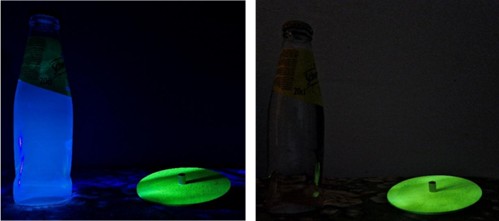
The Baccalaureate of Excellence is a program that allows students to deepen and carry out a research project allowing them to come into contact with the scientific world. Light is a physical phenomenon that is directly related to chemistry and can be easily studied through substances present in our daily lives. Through elements such as tonic, turmeric or luminescent bars, different luminescent phenomena can be studied, such as fluorescence, phosphorescence and chemiluminescence, while at the same time providing knowledge of the historical relevance of quantum chemistry. In addition, experimental work enables students to acquire competences and skills for the application of the scientific method.
References
P. Douglas, M. Garley, Science in School 2010, 14, 63-68.
L. Peña, Revista Digital Universitaria 2018, 19(3), http://doi.org/10.22201/codeic.16076079e.2018.v19n3.a1.
P. B. O’Hara, W. St. Peter, C. Engelson, J. Chem. Educ. 2005, 82, 49-52, https://doi.org/10.1021/ed082p49.
S. Heredia Avalos, Rev. Eureka Enseñ. Divul. Cien. 2008, 5(3), 377-381, https://doi.org/10.25267/Rev_Eureka_ensen_divulg_cienc.2008.v5.i3.12.
H. H. Jaffe, A. L. Miller, J. Chem. Educ. 1966, 43(9), 469-473, https://doi.org/10.1021/ed043p469.
E. Welsh, Science in School 2011, 19, 62-68.
M. Hamer, A. M. Beraldi, S. G. J. Gómez, F. Ortega, D. Onna, M. Hamer, J. Chem. Educ. 2021, 98(8), 2625-2631, https://doi.org/10.1021/acs.jchemed.1c00328.
D. Wong, “Fluorescence and Phosphorescence”, disponible en https://chem.libretexts.org/Bookshelves/Physical_and_Theoretical_Chemistry_Textbook_Maps/Supplemental_Modules_(Physical_and_Theoretical_Chemistry)/Spectroscopy/Electronic_Spectroscopy/Fluorescence_and_Phosphorescence, consultado (04/03/2026).
S. G. Schulman, R. M. Threatte, A. C. Capomacchia, W. L. Paul, J. Pharm. Sci. 1974, 63, 6, 876-880, https://doi.org/10.1002/jps.2600630615.
J. R. Lakowicz en Principles of fluorescence spectroscopy, (Eds.: J. R. Lakowicz), Springer, Boston, 2006, 333-351, https://doi.org/10.1007/978-0-387-46312-4_9.
S. Badui Dergal, Química de los alimentos, Pearson, México, 2006.
F. Qu, N. Gong, S. Wang, Y. Gao, C. Sun, W. Fang, Z. Men, Dyes Pigm. 2020, 173, 107975, https://doi.org/10.1016/j.dyepig.2019.107975
P.-H. Bong, Bull. Korean Chem. Soc. 2000, 21(1), 81-86, https://doi.org/10.5012/bkcs.2000.21.1.81.
R. Kuttan, P- Bhanumathy, K. Nirmala, M. C. George, Cancer Lett. 1985, 29(2) 197-202, https://doi.org/10.1016/0304-3835(85)90159-4.
R. M. Caraballo, L. M. S. Medina, S. G. J. Gomez, P. Vensaus, M. Hamer, J. Chem. Educ. 2021, 98(3), 958-965, https://doi.org/10.1021/acs.jchemed.0c01165.
H. H. Tonnesen, en Phenolic Compounds in Food and Their Effects on Health I ACS Symposium Series, Vol. 506 (Eds.: C.-T. Ho, C. Y. Lee, M.-T. Huang), ACS Publications,Washington, 1992, pp. 143-153, https://doi.org/10.1021/bk-1992-0506.ch011.
P. Drössler, W. Holzer, A. Penzkofer, P. Hegemanm, Chem. Phys. 2002, 282(3), 429-439, https://doi.org/10.1016/S0301-0104(02)00731-0.
H. Diehl, R. Markuszewskis, Talanta 1989, 36(3), 416-418, https://doi.org/10.1016/0039-9140(89)80213-9.
T. S. Kuntzleman, K. Rohrer, E. Schultz, J. Chem. Educ. 2012, 89(7), 910-916, https://doi.org/10.1021/ed200328d.

This work is licensed under a Creative Commons Attribution-NonCommercial-ShareAlike 4.0 International License.
Copyright (c) 2026 Anales de Química de la RSEQ