
Keywords
Science outreach
Chemical elements
History of Science
Spanish Enlightenment
Madrid
Scientific tourism
- Abstract 498
- PDF (Español) 290
- HTML (Español) 41
Abstract
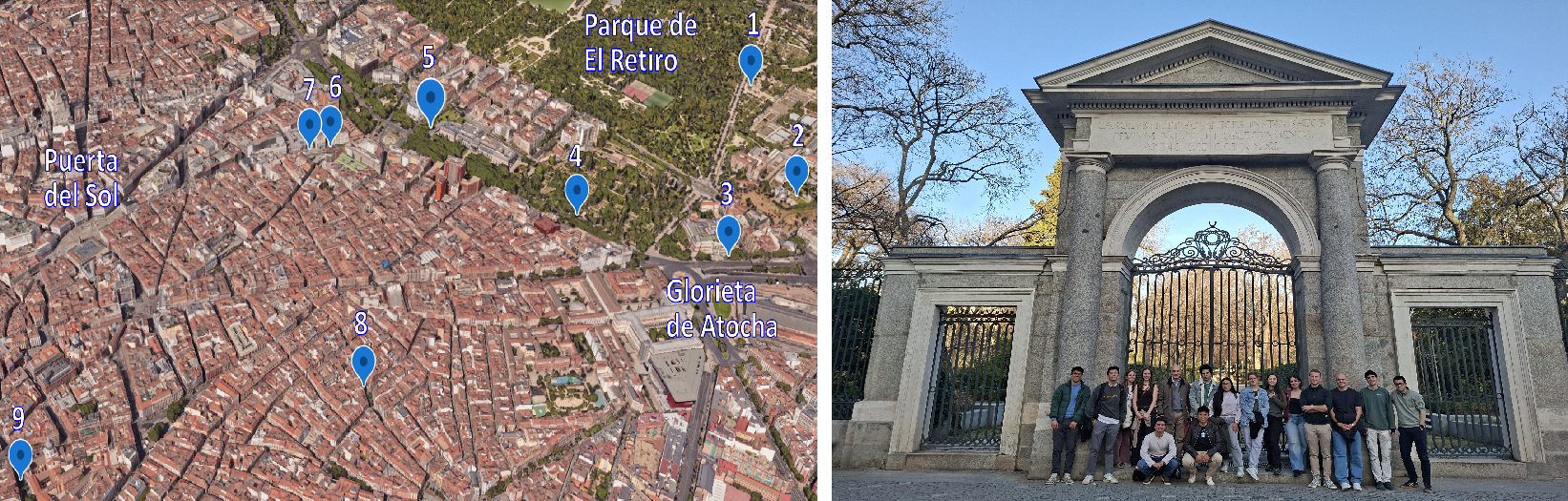
An educational and outreach itinerary through Madrid is presented, linking urban spaces with the Spanish Enlightenment and with the discovery of three chemical elements—platinum, tungsten, and vanadium—by Spanish scientists. The activity is integrated into previous outreach and Service‑Learning projects aimed at diverse audiences, and seeks to promote understanding of the relationships among Science, Technology, Society, History, and Art. The route, partly located within the current Paisaje de la Luz (a UNESCO World Heritage Site since 2021), is structured into eight stages that contextualize royal manufactories, scientific institutions, and key figures of the eighteenth century. The contributions of Antonio de Ulloa—discoverer of platinum and member of the Geodesic Mission—of the Delhuyar brothers—who isolated tungsten—and of Andrés Manuel del Río—who identified erythronium, later renamed vanadium—are highlighted. Each stop incorporates brief explanations of scientific processes, historical controversies, and connections between Spain and the Viceregal America.
References
G. Pinto, V. Alcázar, M. Martín-Conde, Á. Agüero, M. P. Arrieta, F. R. Beltrán, P. García-Muñoz, J. A. Sepúlveda, Advances in Building Education (ABE), 2025, 9(1), 9-30.
G. Pinto, V. Alcázar, M. Martín Conde, en Experiencias y estrategias de innovación educativa en ciencia, tecnología, ingeniería y matemáticas (IV), (Eds.: M. González Montero de Espinosa, A. Herráez Sánchez), Grupo SM, Madrid, 2025, pp. 207-217, https://doi.org/10.5281/zenodo.14009507.
G. Pinto, M. Martín Conde, A. Agüero, V. Alcázar, N. Arabbaseri, M. P. Arrieta, F. R. Beltrán, P. García Muñoz, M. Isar, I. López Hernández, F. Martín García, C. Matías, “Diseño e implementación de rutas divulgativas STEAM en Madrid: Un proyecto de Aprendizaje-Servicio” disponible en https://zaguan.unizar.es/record/131922, 2023 (consultado: 03/03/2026).
G. Pinto, en Experiencias y estrategias de innovación educativa en ciencia, tecnología, ingeniería y matemáticas (III) (Eds.: M. González Montero de Espinosa, A. Herráez Sánchez), Grupo SM, Madrid, 2023, pp. 155-163.
T. Munck, G. G. Djembé, Historia social de la Ilustración, Crítica, 2001.
D. Outram, The enlightenment, Cambridge University Press, 2019, https://doi.org/10.1017/9781108341233.
A. Lafuente, N. Valverde Pérez. Los mundos de la ciencia en la Ilustración Española, Fundación Española para la Ciencia y Tecnología, 2003.
A. J. Kuethe, K. J. Andrien, The Spanish Atlantic world in the eighteenth century: War and the Bourbon Reforms, 1713-1796, Cambridge University Press, 2014. https://doi.org/10.1017/CBO9781107338661.
C. M. Mañueco Santurtún, Bol. Soc. Esp. Ceram. Vidrio 1999, 38(4), 335-344.
L. Herranz Durández, Del Observatorio Astronómico a la Virgen de Atocha (Madrid): una historia de oportunidades perdidas, E.T.S. Arquitectura (UPM), Madrid, 2017.
J. M. Sánchez-Ron, Phys. perspect, 2006, 8, 318-343, https://doi.org/10.1007/s00016-005-0261-3.
J. F. Guillén Tato, Los tenientes de navío Jorge Juan y Santacilia y Antonio de Ulloa y de la Torre-Guiral y la medición del Meridiano, Caja de Ahorros de Novelda, Madrid, 1973.
G. Pinto, J. Chem. Educ. 2017, 94(7), 970-975, https://doi.org/10.1021/acs.jchemed.6b01007.
A. Gutiérrez Escudero, en Actas del II Centenario de don Antonio de Ulloa (Eds.: M. Losada, C. Varela), CSIC - Escuela de Estudios Hispanoamericanos (EEHA), 1995, 257-270.
“Palacio de Fomento”, disponible en https://es.wikipedia.org/wiki/Palacio_de_Fomento, 2025 (consultado: 18/06/2026).
“Antonio de Ulloa”, disponible en https://es.wikipedia.org/wiki/Antonio_de_Ulloa, 2026 (consultado: 18/06/2026).
C. Añón, Real Jardín Botánico de Madrid: sus orígenes, 1755-1781, Real Jardín Botánico CSIC, Madrid, 1987.
A. Rodríguez, Expediciones científicas españolas del siglo XVIII, Edaf, Madrid, 2023.
P. D. Cano, De re metallica (Madrid), 2016, 27, 47-56.
L. Paret y Alcázar, “El Jardín Botánico desde el Paseo del Prado”, disponible en https://www.museodelprado.es/coleccion/obra-de-arte/el-jardin-botanico-desde-el-paseo-del-prado/e7d3ff35-7cfe-42a6-90f2-64737fb96c54, 1792 - 1799 (consultado: 18/06/2026).
P. Román Polo, en La proyección mundial de los hermanos Delhuyar en el campo de la ciencia y de la economía (Eds.: S. Ibáñez), Universidad de La Rioja, 2022, pp. 121-166.
I. Pellón González, en XI Congreso de la Sociedad Española de Historia de las Ciencias y de las Técnicas (Eds.: J. M. Urkia), Real Sociedad Bascongada de los Amigos del País, Guipúzcoa, 2012, pp. 27-62.
P. Román Polo, en Entre la alquimia y la química (Eds.: J. M. Salas, L. F. Vallvey), Editorial Universidad de Granada, 2017, pp. 93-120.
G. Pinto, An. Quím. 2020, 116(1), 38-42.
O. Puche Riart, Fundetel 2001, 5, 72-84.
P. Román Polo, ConCIENCIAS. Digital 2019, 24, 38-55.
G. Pinto, Educ. Quím. 2022, 33(4), 143-155, https://doi.org/10.22201/fq.18708404e.2022.4.0.82131.

This work is licensed under a Creative Commons Attribution-NonCommercial-ShareAlike 4.0 International License.
Copyright (c) 2026 Anales de Química de la RSEQ